Netflix and AI in anime: progress or threat?
The streaming platform presents Go-with-the-Flow, a new AI technology that promises to transform the anime industry, but at what cost?
 Laura Martínez 29 January 2025
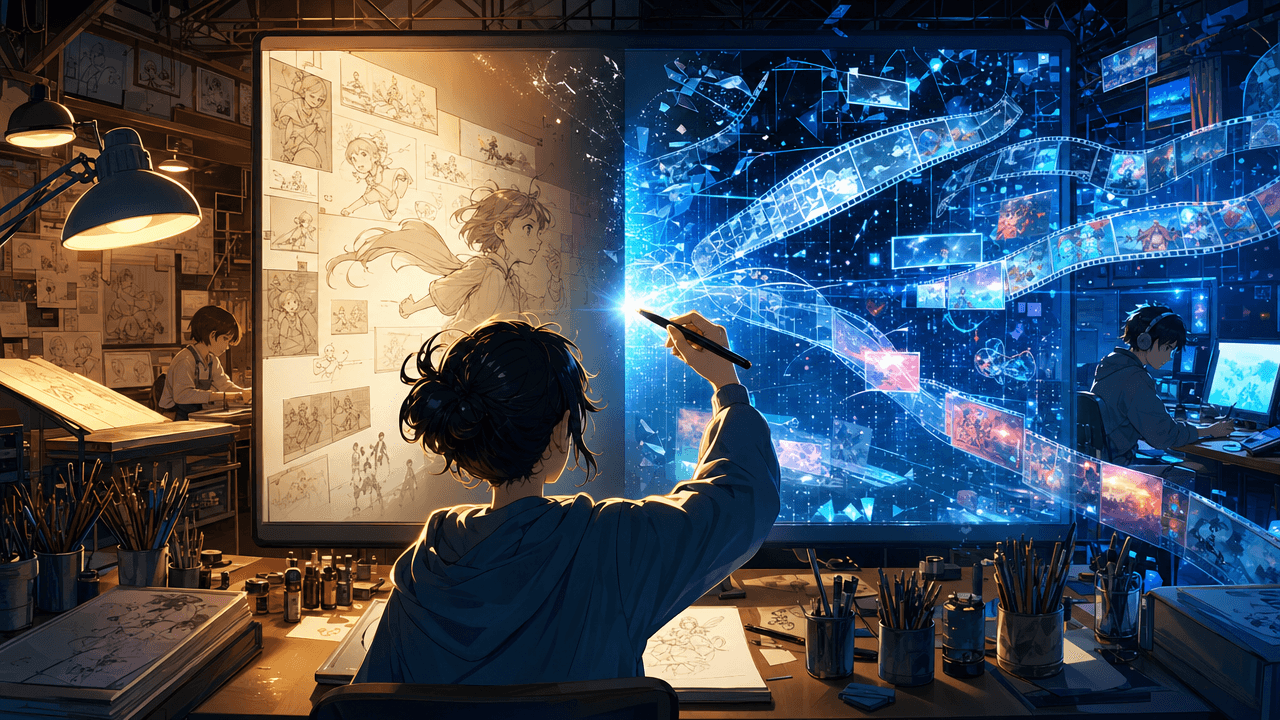 AI-generated image
Netflix bets on AI in anime: what we know so far
Netflix has taken another step in integrating artificial intelligence into the anime industry. Its latest project, Go-with-the-Flow, is a technology that allows manipulating the movement of objects and the camera in AI-generated videos. With just a few clicks, a static image can come to life or a change in a single frame can be automatically applied to the entire animation without manual editing.
This development has been presented by a research team made up of Netflix, Eyeline Studios, Brook University, the University of Maryland, and Stanford University. Although it has initially been tested on live-action images, the creators themselves have made it clear that the goal is to apply it to animation in the future.
A revolution in animation or a problem for the industry?
The purpose of Go-with-the-Flow is to reduce costs and make content production more accessible, allowing more creators to generate high-quality animations without the enormous resources the industry currently requires. However, this innovation brings with it significant concerns, especially regarding the use of copyrighted material.
The AI model behind this technology has been trained with millions of videos, but so far it has not been revealed where that data comes from. This has raised doubts about whether protected works have been used without the consent of their creators, an increasingly common problem in the development of artificial intelligence for the creative industry.
Netflix and its relationship with AI in anime
This is not the first time Netflix has shown interest in using artificial intelligence to optimize anime production. Taiki Sakurai, head of anime production at Netflix and producer of Cyberpunk: Edgerunners, has expressed on several occasions his concern about the shortage of animators in Japan.
According to Sakurai, AI could reduce the production time of an animated film from three years to just one, and decrease the necessary work team from between 700 and 800 people to only 100. This approach would allow the anime industry to remain active despite the lack of personnel, but it raises serious doubts about the impact on jobs within the sector.
The dark side of technological advancement in anime
Although reducing production times and costs sounds attractive from a consumer standpoint, many industry professionals consider AI to be a threat to animators and creators.
The Association of Japanese Animations (AJA) has criticized on several occasions a "global streaming service" (believed to be Netflix) for not paying royalties and applying a single payment model divided over several years. This directly harms animation studios, which already face difficult working conditions.
Furthermore, the use of AI in anime could affect the artistic quality of productions. Japanese animation is known for its unique style, full of detail and emotion, elements that could be lost if artificial intelligence replaces human animators.
What does this mean for anime fans?
The advancement of artificial intelligence in the anime industry leaves us with a dilemma. On one hand, the possibility of faster and more accessible productions is attractive. On the other, the concern that the art and creativity of animators will be diluted in an automated process is legitimate.
As Netflix and other companies continue to experiment with AI, the anime industry faces a transformation that could change it forever. Is this the future of anime that fans want to see?
0 comments
Sign in to leave a comment
Tell everyone what you think about this story.
No comments yet. Be the first.
Keep reading

Egao no Taenai Shokuba desu: The anime that portrays the chaotic world of manga now has its first trailer
Javier Fernández · 28 February 2025

Fire Force Season 3: Release Date, Trailer, and Exclusive Details
Juan Castillo · 27 February 2025

Dragon Ball Evolution: The Disaster That Revived the Legend
Juan Castillo · 26 February 2025