An 80-year-old professor's suspended tea room that looks straight out of Ghibli
Terunobu Fujimori's 'Flying Mud Boat' hangs only from steel cables in Nagano and can be visited exclusively by prior reservation
 Javier Fernández 5 November 2026
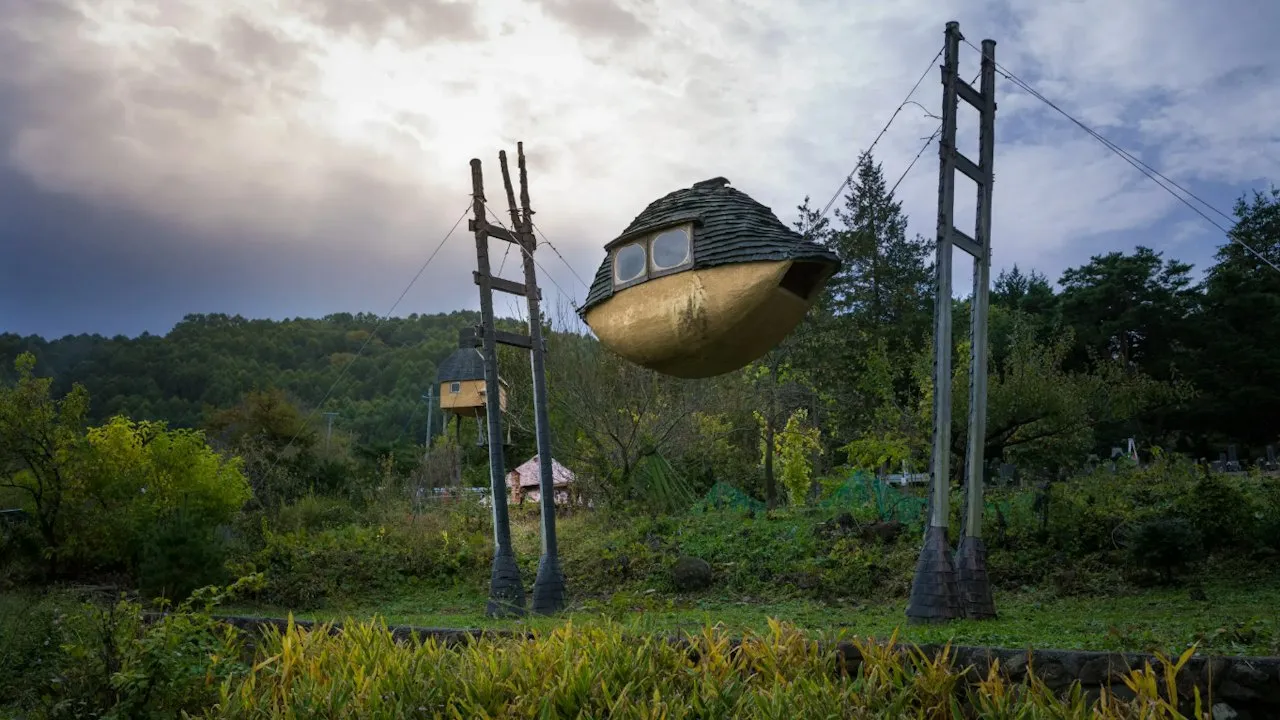
A tea room with no foundations, held in the air by steel cables, has become one of the most shared images from Japan in recent weeks. The Flying Mud Boat (空飞泥舟), built in 2010 in the city of Chino, Nagano Prefecture, hangs several meters above the ground and can only be visited on guided tour days with prior reservation. Its creator is Terunobu Fujimori, an architectural historian and professor emeritus at the University of Tokyo, who turns 80 this year.
The structure was built for a special exhibition at the Chino Art Museum. Fujimori led a collective project in which local residents took part. As reported by Offbeat Japan, the building combines mud mortar, hand-cut wooden planks, and a copper roof. There is no concrete in the base: the weight is distributed among several high-strength cables that keep the cabin suspended.
The result is a piece that seems to float. The comparison with the impossible architectures of Studio Ghibli films has been immediate on social media, where many users describe the ensemble as a Miyazaki world built at full scale. The fragile appearance contrasts with the real weight of the cabin, designed to withstand controlled visits for more than a decade.
You enter via a ladder and a trapdoor
Access is not conventional. The room remains locked outside visiting hours. On authorized days, staff place a wooden ladder under the vessel and visitors climb on all fours through a narrow opening in the hull. The interior, lined with wood, has a circular window and a skylight. Tea is served there while the cabin sways slightly with the wind.
Fujimori did not design an isolated piece. A few meters away stand two other tea rooms that are part of the same ensemble. Takasugi-an (高过庵), completed in 2004, rests on two chestnut trunks six meters above the ground. To enter, you have to climb a ladder. Time magazine once included it among the most striking constructions in the world. In its shadow, the architect dug a hole and built Hikusugi-an (低过庵), a semi-underground room.
The three pieces share a common logic: natural materials, irregular shapes, and an uneasy relationship with the ground. They are not exhibition pavilions in the usual sense, but small-scale habitable spaces that force those who enter to adapt to the architecture, not the other way around.
Visits from April to November, weather permitting
The Chino city government organizes guided tours of Fujimori's tea rooms between April and November. They are available in Japanese and English. Capacity is limited because the natural materials degrade easily, and in winter access is cut off due to snow and ice. A reservation does not guarantee entry: if weather conditions are bad, the visit to the Flying Mud Boat is canceled.
International attention has put the hanging pavilion back in the spotlight. Images have been circulating for weeks on forums and social media, and the guided tour is already taking reservations for the next season. Anyone who wants to climb up to the suspended tea room will have to fit into the visiting calendar and hope that the chosen day has no strong wind or rain.
0 comments
Sign in to leave a comment
Tell everyone what you think about this story.
No comments yet. Be the first.
Keep reading

Atelier of Witch Hat clothing arrives in January with AIR TOKYO
Juan Castillo · 5 November 2026

Yō Fukaya publishes volume of his manga about his 93-year-old father
Juan Castillo · 5 November 2026

comilio celebrates 2 years with manga by Kitada Ryōma and new features
Mariana García · 5 November 2026