AI can create a hundred Nezhas, but it doesn't know which one to choose: Huang Wei's lesson
An exhibition in Shanghai brings together more than 30 original sketches from 'Nezha Conquers the Dragon King' and 'Legend of Sealed Book', and opens the debate on the future of hand drawing.
 Mariana García 22 October 2026
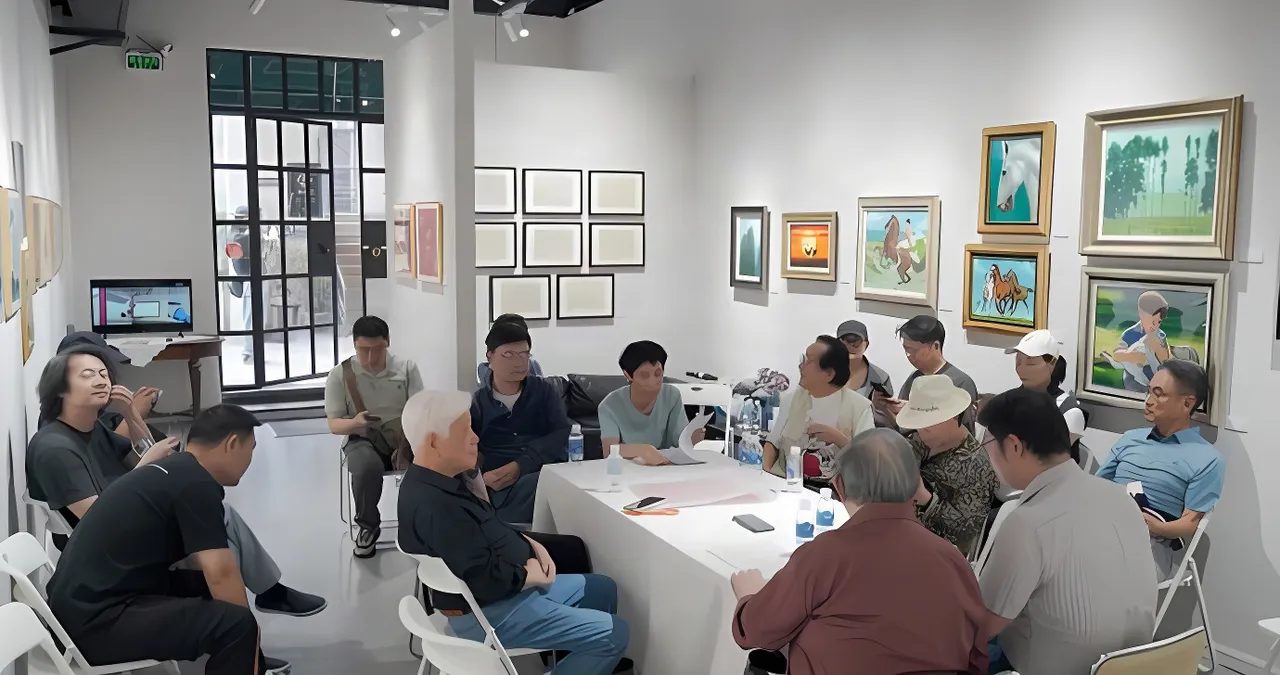
Artificial intelligence can generate a hundred versions of Nezha in a second. But it doesn't know which one to choose. That idea sums up the spirit of the exhibition "Nezha on the Crest of the Wave and the Heavenly Book in the Clouds", on display at the Rui Pin gallery in Shanghai with more than thirty original sketches by Huang Wei, one of the key artists of the golden age of Chinese animation.
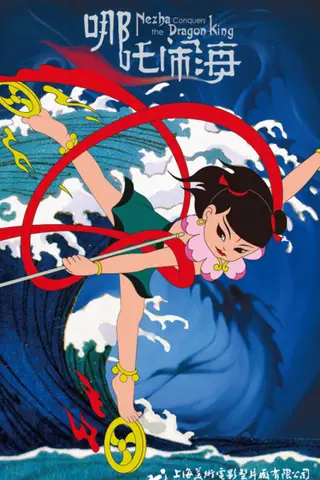
Huang Wei worked as an art designer at Shanghai Animation Film Studio and took part in two essential titles: Nezha Conquers the Dragon King (1979) and Legend of Sealed Book (1983). In the first, he collaborated with Zhang Ding to turn the main designs into animation models. In the second, he was in charge of refining the characters of Dansheng, the fox, and the little emperor.
The show includes thematic sketches from both films, some oil paintings, and documents. Huang Wei is 85 years old and during the opening he stood in front of the drawings from Legend of Sealed Book with a phrase that says it all: "I still have a steady hand for drawing, but my eyesight is starting to fail a bit."
The decision no machine can make
Curator Li Lei explained why this material matters right now. AI imitates Zhang Ding's line, but it doesn't understand why that line turns a certain way. "What Huang Wei's generation left behind is not just how to draw, but why draw it that way," he said. That judgment comes from the Dunhuang murals, New Year prints, and Chinese opera masks. It is the visual grammar of the country's animation.
And that grammar shows up in concrete decisions. During the production of Nezha Conquers the Dragon King, there was a debate about the protagonist's physique. Some defended a thin, wiry Nezha, because young heroes in Chinese tradition often came from poor families. Others pointed out that in New Year prints children are always chubby. Director Wang Shuchen settled the discussion: Nezha was the son of a commander, from a well-off family, so he should be fair-skinned and sturdy, not skinny and dark.
Zhang Ding listened to the arguments and opted for a plump, strong character, true to customs and popular taste. Huang Wei and his team later adapted that design to the technical needs of animation. A fine-tuning job that was repeated with Dansheng, the boy from Legend of Sealed Book: Ke Ming's first design was elongated, but kept the egg shape in the torso. Huang Wei and Ma Kexuan refined it into the final version.
"Don't imitate others, don't repeat yourself"
Huang Wei recalled a phrase by director Wang Shuchen that worked as a creative standard at the studio: "Don't imitate others, don't repeat yourself." Under that rule, characters were born that decades later still hang on fans' walls.
The panel organized alongside the exhibition included veteran artists from Shanghai Animation Film Studio. Dong Jinsheng, designer and screenwriter, highlighted Huang Wei's ability to open himself to new horizons. Faced with the advance of AI, he said, the most valuable thing is still human imagination and soul. Creation, not technique, is what matters for an artist.
Yin Xiyong, director of Black Cat Detective, shared an anecdote from Dai Tielang, director of that series: the studio's big productions needed "marshal-level" directors, capable of seeing the whole battlefield and not just the details. Wang Shuchen was one of them. He had an eye for recruiting talent like Huang Wei or Yan Shanchun. "Huang Wei's line is among the best in the studio's style: precise, firm, and rigorous," he said.
Shi Yi, director of the ink short film The Flight of the Antelopes, gave a recent example. Four or five years ago someone proposed integrating AI into that production. He rejected it: the technology of the time couldn't reproduce the artisanal process that a work with that level of manual labor demands. The film was finished this year and one of its rules was clear: not a single shot with any trace of AI.
The river has two stretches
Jin Baisong, animation theorist at the studio, used a river metaphor: traditional animation is the upper course of the river and digital animation, the lower course. One is born from the other. That's why he argues that people exploring AI are needed, but also preserving the artistic advantage accumulated by Shanghai Animation Film Studio over decades.
The discussion was moderated by Wang Hongjia, founder of the Kongzang animation documentation archive, and brought together professors from several Chinese universities. Topics on the table: the limits of AI in creation, how to maintain aesthetic judgment in teaching, and what kind of professionals the industry needs.
Huang Wei's exhibition is a chance to see up close the originals of two films that defined Chinese animation. And also a reminder that, no matter how fast a machine generates images, someone has to decide which of all those images is worth keeping.
Titles mentioned
0 comments
Sign in to leave a comment
Tell everyone what you think about this story.
No comments yet. Be the first.
Keep reading
Lucca Comics & Games 2026 celebrates 60 years with tribute to Go Nagai and spokon
Mariana García · 19 October 2026
Jōmon art comes to Niimi: manga artist Sakai exhibits 150 original works
Mariana García · 19 October 2026
MangaNow Award 2026 adds former patent examiner as judge
Mariana García · 18 October 2026