CCTV Dedicates Special to Chengdu's Animation Industry with the Success of Ne Zha and Ba Xian!
A 45-minute report looks back at how the city went from outsourcing work to producing three of China's highest-grossing animated films.
 Mariana García 10 October 2026
China's state television has set its sights on Chengdu's animation industry. CCTV's News Investigation program aired a 45-minute special on October 10 dedicated to the city's digital production, and it did so with an impressive figure: the film Ba Xian! has already surpassed 2 billion yuan at the box office.
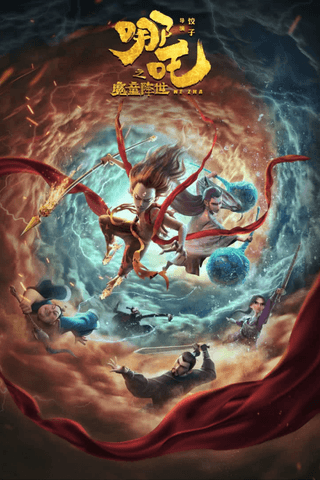
With that number, the film ranks as the third highest-grossing Chinese animated film in history. The top two were also born in Chengdu: Ne Zha 2, with 15.446 billion yuan, and Ne Zha, with 5.035 billion.
The report doesn't stop at the numbers. It goes back to the 1990s, when animation in Chengdu began with outsourcing work: Chinese artists did inking, coloring, and in-between frames for foreign productions. From there, they moved on to their own projects, with some stumbles along the way. In 2006, Thru the Moebius Strip premiered, a 130 million yuan bet and five years of work that barely grossed 3 million, but it trained an entire generation of animators.
The special also recalls the case of One Hundred Thousand Bad Jokes. In 2012, the team of Li Shujie and Lu Hengyu adapted the webcomic with an initial budget of only 20,000 yuan for the first episode. The series became a phenomenon, and in 2014 its movie grossed 119 million yuan with a production cost of just 5 million.
The panda that has been 14 years in the making
One of the most interesting moments in the special is the story of Wu Honglian. This creator founded his studio in Chengdu in 2012 and has been working on Pango y Pakun ever since, an IP starring a panda. Pango's stickers launched in 2017 and have already accumulated more than 50 million downloads and 500 million sends.
Wu puts it bluntly: he has been with the project for 14 years and "is not anxious at all." He also acknowledges that animation is an industry where mistakes are costly, in both time and money. His case contrasts with big film productions: it's the slow path, the one of building an audience little by little.
The report makes one idea clear: a box office hit brings visibility, but what sustains an IP in the long run is the complete chain. Comics, animation, film, video games, and merchandise have to work together.
From the studio to the streets during National Day
The other side of the special is how all that content spills into the real world. During the National Day holiday week, the Eastern Suburb Memory district in Chengdu put on an architectural projection show every night at 8. The characters from Ba Xian! appeared as inflatable figures, and the line to take photos with them never stopped.
The numbers back up the excitement: the digital light and shadow art festival received more than one million visitors and generated revenue of over 45 million yuan, a 29.1% increase over the previous year. The merchandise street, with more than 40 local IPs and nearly a thousand items, welcomed 326,000 people, up 48%.
It wasn't all Ba Xian!. The first immersive experience of Harry Potter: Magic Awakened in China debuted there, and Honor of Kings presented its first interactive VR drama. Even the game Catch the Goose brought its IP to the tourist landscapes of Dujiangyan.
An industry that keeps growing
The CCTV special also visits the Tianfu Changdao industrial park, home to more than 70 companies dedicated to IP, design, animation, visual effects, and dubbing. Physical proximity reduces communication costs and speeds up projects.
The macro data confirms the trend: in 2025, Chengdu's digital and cultural industry reached a size of 413.970 billion yuan, with an annual growth of 8.3%. In 2026, the park opened the OPC Community, a space for individual creators and small teams with access to computing power and shared offices.
The report closes with a clear bet: generative artificial intelligence is lowering the barriers to entry for producing animated comics and digital video. You no longer need a big studio to create, but the challenge remains the same: getting ideas to find financing, distribution, and market.
What do you think of this industry model? Do you think something like this could work in Latin America? Let us know in the comments.
Titles mentioned

0 comments
Sign in to leave a comment
Tell everyone what you think about this story.
No comments yet. Be the first.